Espace EUGLOH
Section outline
-
-
The European University Alliance for Global Health
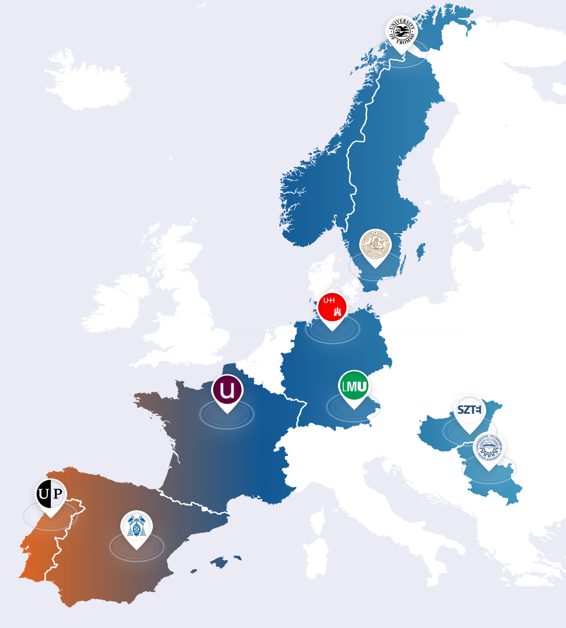
L’alliance européenne EUGLOH permet aux étudiant·es de tous niveaux (de la licence au doctorat) et aux personnels académiques et administratifs d’accéder à des campus virtuels et physiques à travers l’Europe, avec des activités et opportunités de mobilité, notamment des programmes de formation courts et longs, ainsi que des opportunités de coopération en enseignement et recherche avec des spécialistes de renommée mondiale.
Cette alliance regroupe l’Université Paris-Saclay, la Ludwig-Maximilians-Universität München (Allemagne), l’Université de Lund (Suède), l’Université de Porto (Portugal), l’Université de Szeged (Hongrie), l'Université d'Alcalá (Espagne), The Arctic University of Norway (Norvège), l'Université de Novi Sad (Serbie) et l'Université de Hambourg (Allemagne). L'Université d'Amsterdam rejoint l'alliance à partir de 2027.
Découvrez l'alliance : www.eugloh.eu
-
-
Vous êtes étudiant·e à l'Université Paris-Saclay, vous êtes donc étudiant·e EUGLOH !
Vous n'avez plus qu'à vous inscrire aux cours et activités qui vous intéressent.
Pour cela, rien de plus simple :
1. Rendez-vous sur la page Courses & Trainings de EUGLOH : https://www.eugloh.eu/courses-trainings/ pour consulter les activités et cours proposés actuellement.
2. Cliquez sur "Course Information" sous l'activité qui vous intéresse. La page qui s'affiche vous donnera toutes les informations à propos de l'activité : programme, format (en ligne, en présentiel, ou les deux), à qui s'adresse l'activité, durée, date limite d'inscription, modalité de sélection, etc.
3. Si vous voulez participer à l'activité, cliquez sur le bouton orange "Find out more and register now" et remplissez le formulaire.
4. Attendez de recevoir l'e-mail qui vous annonce si vous êtes sélectionné·e. Cet email vous sera envoyé après la date butoir des inscriptions.
5. Une fois l'e-mail reçu :
- Si c'est une activité en ligne, vous recevrez le lien de connexion quelques jours avant l'évènement.
- Si c'est une activité en présentiel dans une des universités partenaires, vous recevrez dans les 15 jours un e-mail de la part de mobility.eugloh@universite-paris-saclay.fr qui vous indiquera les formalités à suivre afin de valider votre participation. (Si vous n'avez pas reçu d'email au bout 15 jours après avoir été sélectionné, écrivez à mobility.eugloh@universite-paris-saclay.fr).
👉 N'hésitez pas à consulter la page Courses & Trainings de EUGLOH régulièrement, car de nouveaux cours et activités sont ajoutés en permanence.
❗ Important :
1. Vous devez informer votre responsable de formation de votre inscription afin d’obtenir son accord, notamment en cas d’absence aux enseignements prévus dans votre cursus !
2. De plus, même si une activité attribue des crédits ECTS par l'établissement organisateur, la reconnaissance de ces crédits n’est pas automatique car elle dépend de la validation par votre responsable de formation. Il est donc impératif d’anticiper cette démarche en informant en amont votre responsable de formation de votre intention de participer à une activité EUGLOH.🇬🇧 Tous les cours et activités sont dispensés en anglais, un niveau B1 est recommandé. Cela dit, plus vous participerez aux activités EUGLOH, plus vous progresserez en anglais !
📧 Si vous avez un doute ou une question, contactez l'équipe EUGLOH à l'Université Paris-Saclay : eugloh@universite-paris-saclay.fr
À bientôt !
-
-
-
➡️ Lien d'inscription et informations complètes
Type: Blended (Physical: 3 Oct 2026 10:00 - 4 Oct 2026 15:00 Online: 5 Sep 2026 16:00 - 26 Sep 2026 19:00)
Location: University of Novi Sad
ECTS: 5
Target groups: Undergraduate students, Master students, PhD students
Description: This course aims to familiarise students with the significance of mushrooms as both beneficial organisms used in nutrition and medicine (functional food) and as microorganisms capable of producing toxins harmful to human health. Students will learn about the basic morpho-anatomical features of edible mushrooms, their nutritional value, key medicinal and toxic species, the chemistry of toxic substances, poisoning syndromes, and first aid measures.
-
➡️ Lien d'inscription et informations complètes
Type: Blended (Physical: 23 Oct 2026 11:00 - 24 Oct 2026 15:30 and Online: 14 Sep 2026 09:00 - 20 Oct 2026 13:00)
Location: University of Novi Sad
ECTS: 3
Target groups: Undergraduate students, Master students, PhD students
Description: This hybrid course introduces participants to problem solving using the open-source programming languages R and Python.
Through a combination of online sessions and an onsite component at the University of Novi Sad, participants will gain practical skills in data manipulation, visualization, statistical analysis, and introductory machine learning.
The course is designed for students from different backgrounds who are interested in learning how to analyze data and approach real-world problems using modern open-source tools.
By the end of the course, participants will be able to work with data in R and Python, apply basic analytical methods, and collaborate on a practical project that integrates the knowledge and skills acquired throughout the program.In the initial week, participants will acquire introduction to the R and Python programming languages, encompassing the setup of the environment, basic syntax, data types, as well as fundamental data manipulation and analysis.
Moving on to the second week, the learning objectives will revolve around data input/output, employing dplyr in R and pandas in Python for data manipulation, and utilizing ggplot2 in R as well as matplotlib/seaborn in Python for data visualization.
The focus of the third week will shift towards statistical analysis using R and Python, accompanied by an introduction to machine learning. Supervised learning algorithms, including linear regression, logistic regression, decision trees, and random forests, will be introduced.
In the concluding phase, the final project will require students to engage in a practical application of their acquired skills and concepts. This project will involve working with R and/or Python to demonstrate proficiency in the tools and methodologies learned throughout the course.