Résumé de section

    • The European University Alliance for Global Health
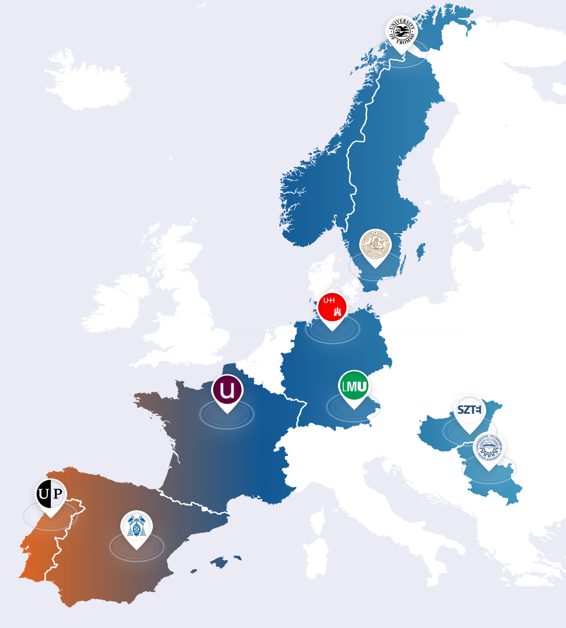
      L’alliance européenne EUGLOH permet aux étudiant·es de tous niveaux (de la licence au doctorat) et aux personnels académiques et administratifs d’accéder à des campus virtuels et physiques à travers l’Europe, avec des activités et opportunités de mobilité, notamment des programmes de formation courts et longs, ainsi que des opportunités de coopération en enseignement et recherche avec des spécialistes de renommée mondiale.
      Cette alliance regroupe l’Université Paris-Saclay, la Ludwig-Maximilians-Universität München (Allemagne), l’Université de Lund (Suède), l’Université de Porto (Portugal), l’Université de Szeged (Hongrie), l'Université d'Alcalá (Espagne), The Arctic University of Norway (Norvège), l'Université de Novi Sad (Serbie) et l'Université de Hambourg (Allemagne). L'Université d'Amsterdam rejoint l'alliance à partir de 2027. 
      Découvrez l'alliance : www.eugloh.eu


      • Vous êtes étudiant·e à l'Université Paris-Saclay, vous êtes donc étudiant·e EUGLOH !
        Vous n'avez plus qu'à vous inscrire aux cours et activités qui vous intéressent. 
          LOGO EUGLOH


        Pour cela, rien de plus simple :

        1. Rendez-vous sur la page Courses & Trainings de EUGLOH : https://www.eugloh.eu/courses-trainings/ pour consulter les activités et cours proposés actuellement.

        2. Cliquez sur "Course Information" sous l'activité qui vous intéresse. La page qui s'affiche vous donnera toutes les informations à propos de l'activité : programme, format (en ligne, en présentiel, ou les deux), à qui s'adresse l'activité, durée, date limite d'inscription, modalité de sélection, etc. 

        3. Si vous voulez participer à l'activité, cliquez sur le bouton orange "Find out more and register now" et remplissez le formulaire.

        4. Attendez de recevoir l'e-mail qui vous annonce si vous êtes sélectionné·e. Cet email vous sera envoyé après la date butoir des inscriptions. 

        5. Une fois l'e-mail reçu :

        • Si c'est une activité en ligne, vous recevrez le lien de connexion quelques jours avant l'évènement.


        👉 N'hésitez pas à consulter la page Courses & Trainings de EUGLOH régulièrement, car de nouveaux cours et activités sont ajoutés en permanence.

        ❗ Important 
        1. Vous devez informer votre responsable de formation de votre inscription afin d’obtenir son accord, notamment en cas d’absence aux enseignements prévus dans votre cursus !
        2. De plus, même si une activité attribue des crédits ECTS par l'établissement organisateur, la reconnaissance de ces crédits n’est pas automatique car elle dépend de la validation par votre responsable de formation. Il est donc impératif d’anticiper cette démarche en informant en amont votre responsable de formation de votre intention de participer à une activité EUGLOH. 

        🇬🇧 Tous les cours et activités sont dispensés en anglais, un niveau B1 est recommandé. Cela dit, plus vous participerez aux activités EUGLOH, plus vous progresserez en anglais !

        📧 Si vous avez un doute ou une question, contactez l'équipe EUGLOH à l'Université Paris-Saclay : eugloh@universite-paris-saclay.fr


        À bientôt !

    • Catalogue des UE libres EUGLOH semestre 1 2026-2027

    • Afin de suivre une UE libre EUGLOH, vous devez effectuer une double inscription :

      1. Via le formulaire ci-dessous Candidater à une UE libre,
      2. Puis sur la page de l'UE concernée au lien dans la description de chaque UE ci-dessous.
    • Candidater à une UE libre

      Pour suivre une de ces UE libres, vous devez d’abord déposer une demande. Après validation par votre scolarité, votre inscription au cours sera effectuée pour vous.

      1. Déposez votre demande

      Remplissez le formulaire de candidature dédié à cette UE libre.

      2. Votre demande est examinée

      Vous recevez une copie de votre demande et votre scolarité vérifie que cette UE peut être intégrée à votre cursus.

      3. Votre inscription est effectuée

      Si votre demande est validée, vous êtes inscrit au cours et recevez une confirmation par courriel.

    • Entrepreneurial Skills

      ➡️ Lien d'inscription et informations complètes

      Type: Blended (Online: 12 Oct 2026 - 18 Dec 2026 and Physical: 14 Dec 2026 08:30 - 15 Dec 2026 17:00).

      Location: Lund University

      ECTS: 1,5

      Target groups: Undergraduate students, Master students

      Requirements: Students must have at least 30 ECTS in any subject. Students with different backgrounds are encouraged to apply since multidisciplinarity will be an asset.

      Description: Today we all acknowledge that global society face a number of challenges that need new and creative solutions. We need to learn how to handle uncertainties and unpredictable situations in a productive and progressive way. To cope with these challenges and uncertainties there is a call for more entrepreneurial knowledge and skills.

      In this 1,5 ECTS course you will learn about entrepreneurship and how to collaborate in intercultural and multidisciplinary teams.

      This course contains four online modules supported by two online lectures. The online modules consist of individual work to be performed before set deadlines. At the end of the course there will be a two-day dynamic "hackathon" on site in Lund, Sweden when the students will work in teams with the task to deliver a solution to a challenge.

      Students will receive a scholarship to meet their costs for travel and living. More information on travel arrangements, accommodation etc. will be sent to accepted students. 

      Learning outcomes:

      The course Entrepreneurial Skills aims to introduce students to:

      • the development process of an entrepreneurial project
      • the entrepreneurial mindset that is needed for the development process to take place
      • the dynamics of teamwork.
    • International Sustainable Innovation

      ➡️ Lien d'inscription et les informations complètes (à venir)

      Type: Physical 5 days - Physical attendance with online preparation (Oct/Nov 2026 - Oct/Nov 2027) 

      Location: University of Tromso (Campus Harstad)

      ECTS: 5

      Target groups: Master Students

      Description: At UiT The Arctic University of Norway, an innovation sprint has been developed in collaboration with innovation hub Norinnova, as part of a course called “RealfagsPraksis.” This course has introduced students to innovation methodologies and has given them to opportunity to work with realistic, practice-oriented problems in interdisciplinary groups.
      Building on the success of this innovation sprint, we are excited to present a new EUGLOH workshop – International Sustainable Innovation. This workshop, focused on real issues related to sustainable innovation, is designed to foster collaboration, problem-solving, and applied knowledge in an international and interdisciplinary context. 
      This workshop is especially relevant for students and staff who are:
      • Working with development, construction and technology in nature-based industries
      • Encountering value conflicts connected to sustainability, environmental impact, and societal considerations

    • EUGLOH Innovation Days

      ➡️ Lien d'inscription et les informations complètes (à venir)

      Type: Physical 3 days (7 Oct 2026 - 9 Oct 2026)

      Location: University of Szeged

      ECTS: 2

      Target groups: Bachelor/Master/PhD/Post-doc

      Description: Innovation Days is an event where students can get closer to innovation from a business perspective.

      Learning outcomes:

      •    Encourage students and researchers to think beyond the regular working schedule
      •    Understanding entrepreneurial thinking
      •    Learning about different tools and methods that are used to carry out marketable ideas
      •    Networking with students from other European universities
      •    Learning about project-based work and tight deadlines
      •    Improving transversal skills

    • Employment and University Related Stress Training (EUReST)

      ➡️ Lien d'inscription et informations complètes

      Type: Blended (Physical: 14 Oct 2026 - 16 Oct 2026 and Online: 5 Oct 2026 - 7 Oct 2026) 

      Location: University of Szeged

      ECTS: 2

      Target groups: Master students, PhD students

      Description: Feeling stressed by university life? Worried about workplace pressure in your future career?
      Join the Employment and University Related Stress Training (EUReST) blended course and gain the knowledge and tools to manage stress—both during your studies and in your future professional life. The training aims to develop soft skills with theoretical and practical methods to help understand and manage stress.

      Who is it for?
      Master’s and PhD students from all academic disciplines who are interested in developing their stress management skills and enhancing their mental well-being.

      Why is it worth joining?

      • Gain insights into stress from medical, psychological, and legal/occupational health perspectives
      • Practice practical tools like exercises, mindfulness, cognitive techniques, and time management
      • Design your own personal stress management plan
      • Collaborate in a group project and present a stress reduction program to a professional jury
      • Special recognition will be awarded to the students

      Course structure:

      Online module (5-7 October): 6 hours of live expert lectures covering medical, psychological, and legal aspects of stress
      In-person training in Szeged (14-16 October): Interactive workshops, practical exercises, self-reflection, and group work

    • Food Culture

      ➡️ Lien d'inscription et informations complètes

      Type: Blended (Physical: 7 Oct 2026 09:00 - 9 Oct 2026 16:30 and Online: 21 Sep 2026 08:30 - 22 Sep 2026 13:45) 

      Location: University of Novi Sad

      ECTS: 3

      Target groups: Undergraduate students, Master students, PhD students

      Description: The course will take place online on 23–24 September and onsite from 7–9 October 2026 at the University of Novi Sad, Serbia. It is intended for students from various disciplines and anyone interested in food, culture, sustainability, and global health.

    • Global History and Politics of Food Security. Interdisciplinary Approaches

      ➡️ Lien d'inscription et les informations complètes (à venir)

      Type: Physical (7th November 2026 - 8th November 2026) 

      Location: University of Hamburg

      ECTS: 3+ (3 ECTS for participation, more upon completion of a term paper of different lengths, according to respective curricula)

      Target groups: Undergraduate students, Master Students (with coursework and assessment requirements appropriate to each level)

      Description: Against the backdrop of an escalating global food crisis – marked by conflict, poverty, and the climate crisis – this class examines the global history and politics of food security since the late nineteenth century, bringing together approaches from history, anthropology and the social and political sciences. We trace how understandings of hunger shifted with the rise of modern nutrition science, when a lack of food came to be defined in terms of caloric or nutrient deficiency. This reframing rendered malnutrition measurable, comparable, and – crucially –governable as a universal problem across diverse populations and food cultures. In this moment, the very concept of global food in/security emerged. Over the course of the twentieth century, various international actors developed competing ways of measuring and diagnosing food in/security, often arriving at divergent assessments – and even disagreeing over whether a famine existed at all.

  • ➡️ Lien d'inscription et informations complètes

    Type: Blended (Physical: 3 Oct 2026 10:00 - 4 Oct 2026 15:00 Online: 5 Sep 2026 16:00 - 26 Sep 2026 19:00)

    Location: University of Novi Sad

    ECTS: 5

    Target groups: Undergraduate students, Master students, PhD students

    Description: This course aims to familiarise students with the significance of mushrooms as both beneficial organisms used in nutrition and medicine (functional food) and as microorganisms capable of producing toxins harmful to human health. Students will learn about the basic morpho-anatomical features of edible mushrooms, their nutritional value, key medicinal and toxic species, the chemistry of toxic substances, poisoning syndromes, and first aid measures.

  • ➡️ Lien d'inscription et informations complètes

    Type: Blended (Physical: 23 Oct 2026 11:00 - 24 Oct 2026 15:30 and Online: 14 Sep 2026 09:00 - 20 Oct 2026 13:00) 

    Location: University of Novi Sad

    ECTS: 3

    Target groups: Undergraduate students, Master students, PhD students

    Description: This hybrid course introduces participants to problem solving using the open-source programming languages R and Python.

    Through a combination of online sessions and an onsite component at the University of Novi Sad, participants will gain practical skills in data manipulation, visualization, statistical analysis, and introductory machine learning.
    The course is designed for students from different backgrounds who are interested in learning how to analyze data and approach real-world problems using modern open-source tools.
    By the end of the course, participants will be able to work with data in R and Python, apply basic analytical methods, and collaborate on a practical project that integrates the knowledge and skills acquired throughout the program.

    In the initial week, participants will acquire introduction to the R and Python programming languages, encompassing the setup of the environment, basic syntax, data types, as well as fundamental data manipulation and analysis.

    Moving on to the second week, the learning objectives will revolve around data input/output, employing dplyr in R and pandas in Python for data manipulation, and utilizing ggplot2 in R as well as matplotlib/seaborn in Python for data visualization.

    The focus of the third week will shift towards statistical analysis using R and Python, accompanied by an introduction to machine learning. Supervised learning algorithms, including linear regression, logistic regression, decision trees, and random forests, will be introduced.

    In the concluding phase, the final project will require students to engage in a practical application of their acquired skills and concepts. This project will involve working with R and/or Python to demonstrate proficiency in the tools and methodologies learned throughout the course.