
STAPS ENGLISH 2025-2026
Course: STAPS ENGLISH 2025-2026 | eCampus
-
 Welcome to this introductory course of STAPS English!This course has been designed as a common core for all our L2 undergraduates; its purpose is to teach you the basics of sporting English!Please note: This course is comprised of both online and in-class lessons (check the syllabus for the program).When you have an online class:- You are free to take your class at any moment during the week (Monday through Sunday); the contents will remain available throughout the semester. If you would like some help from your teacher, you may come to class for this lesson, but it will have to be at your usual English-class time.- We recommend spending at least 1h30 on this class (which is the equivalent of what you would have had for an in-class lesson).- But keep in mind that the time you spend on this class will also depend on your level and motivation. :)- Each online lesson is preparatory for the next in-class lesson: there will be a test in class, so make sure you study well before your in-class lesson (the day before, at the lastest)!
 Bienvenue dans ce cours d'initiation à l'anglais STAPS !
Ce cours a été conçu comme un tronc commun pour tous les étudiants de L2 ; il est destiné à vous apprendre les bases de l'anglais sportif !
NB: Ce cours comprend des TD en ligne et des TD en classe (voir le syllabus pour l'organisation).
Lorsque le TD est en ligne :- Vous êtes libres de faire ce TD en ligne au moment de la semaine que vous préférez (du lundi au dimanche) ; le contenu du TD restera accessible tout au long du semestre. Si vous souhaitez avoir de l'aide de votre professeur, vous pouvez venir en classe, mais dans ce cas cela doit être sur votre créneau habituel d'anglais.- Nous vous recommandons de consacrer au moins 1h30 à ce TD (c'est l'équivalent de la durée d'un TD en classe).- Mais gardez à l'esprit que le temps nécessaire pour achever ce TD dépendra aussi de votre niveau et de votre implication. :)- Chaque TD en ligne sert de préparation au test qui aura lieu lors du TD en classe suivant, donc révisez bien le TD en ligne avant votre TD en classe (au plus tard la veille) !_____________________________________________________________________________________________
We are looking forward to classes with you and hope you will enjoy this year; please feel free to share any feedback with us!Best regards,
Your English teachers Thibaut Nilles & Emma Pillard
-
Here is what you will learn:S38: Meet your English teacher and learn more about this year's program.S39: Study your pronunciation rules and practice.

-
-
 Welcome to your first online class! This class is the first part of UNIT 1.
 In this Unit, you will learn the names of sports and sports facilities in English. For each STEP, we have indicated the approximate time you should spend.
For this Unit, there are 7 STEPS + 1 optional STEP (see below).
PLEASE REMEMBER TO CLICK ON THE LITTLE TICK ICON "
 " on the right side of the screen for each activity, to complete the activity. This allows your teachers to visualize your progression. Moreover, you will not be able to complete certain STEPS unless you reach the minimum score for a test. You may take these tests several times, to practice and complete your STEPS!
 Bienvenue sur votre premier TD en ligne ! Ce TD est la première partie du UNIT 1.
Dans cet UNIT, vous allez apprendre les noms de sports et d'infrastructures sportives en anglais. Pour chaque STEP, nous vous avons indiqué le temps approximatif que vous devriez passer dessus.
Pour ce module, il y a 7 STEPS + 1 STEP facultatif (voir ci-dessous).
ATTENTION MERCI DE VALIDER CHAQUE ÉTAPE TERMINÉE EN CLIQUANT SUR LA PETITE ICÔNE "
" à droite de l'écran liée à l'étiquette ! Cela nous aide à voir votre progression. De
plus, certains STEPS ne pourront pas être validés tant que vous n'avez pas eu
un score minimum sur un test. Vous pouvez passer ces tests plusieurs fois
afin de vous entrainer et de les valider !UNIT 1 STEPS / ÉTAPES :
STEP 1 (Vocabulary) : Watch the video about the Olympic sports pictograms and take the test to see what you have memorized / Regardez la vidéo sur les pictogrammes des sports olympiques puis faites le test pour voir ce que vous avez retenu.
STEP 2 (Listening) : Watch the video about the Paris 2024 sports. / Regardez la vidéo sur les sports qui seront présents aux JO de Paris 2024.
STEP 3 (Phonology) : Study the pronunciation of sports names with the GamestolearnEnglish website (and video, if you need to!). Be careful: keep track of the score you will get with GamestolearnEnglish because you will need it for STEP 7. / Apprenez la prononciation des sports avec le site GamestolearnEnglish (et éventuellement la vidéo qui va avec, si vous voulez !). Attention à bien noter quelque part le score que vous allez obtenir sur GamestolearnEnglish. Il vous sera demandé au STEP 7.
STEP 4 (Vocabulary) : Study the names of sports facilities with a LearningApp. Be careful: keep track of the password you will get when you finish playing the LearningApp game, because you will need it for STEP 7. / Apprenez les noms d'infrastructures sportives avec une LearningApp ; attention à bien enregistrer le mot de passe qui vous est donné lorsque vous avez réussi. Il vous sera demandé au STEP 7.
STEP 5 (Grammar) : Learn which prepositions you should use when talking about sports and the facilities where these sports are practiced. / Apprenez les prépositions à utiliser lorsque vous parlez d'un sport et des infrastructures où vous pratiquez ce sport.
STEP 6 (Vocabulary) : Memorize the rules about when to use DO/GO/PLAY/PRACTICE and take the test to practice. / Mémorisez la règle d'utilisation des verbes DO/GO/PLAY/PRACTICE puis entraînez-vous avec le test.
STEP 7 (Memorize!) : Take the final Wooclap to see what you have memorized! Be careful, you can only take the test ONCE, so make sure that you have done all the activities from each step and that you have your notes with you before you start... / Participez au Wooclap de fin de module, pour voir ce que vous en avez retenu ! Attention, vous ne pouvez passer ce test qu'une seule fois. Soyez sûr d'avoir bien validé toutes les étapes précédentes avant de le passer, et d'avoir vos prises de notes avec vous...
STEP 8, optional (Vocabulary) : This STEP is completely optional! / Ce STEP est complètement facultatif !
GOOD LUCK!
-
-
Students mustMark as done
 STEP 1 - Olympic sports pictograms (⏲️ 10 min)
 a) Go to the following website and memorize the pictograms from the 2024 Paris Olympics.
You can also watch this video to help you memorize all the pictograms with illustrations!=> NB: In English, we never say "the + sport" to talk about a sport in general. / En anglais, on n'utilise jamais "the + sport" pour parler d'un sport de façon générale.Ex:Thesoccer is the most popular sport in the world. <=> Le football est le sport le plus populaire du monde.b) Take the following test to see what you remember: (voir le test ci-dessous) -
-
Students mustMark as done
 STEP 2 - The Paris 2024 Olympic Games
(⏲️ 10 min)
Here is a video of the 45 sports that were present at the Paris 2024 Olympic Games.
a) Repeat out loud all the sports and be sure of the pronunciation.
b) Listen carefully to find the answers to the following questions. Write the answers down somewhere!
- Which sports were dropped compared to Tokyo 2020?
- Which sport was a new Olympic sport in 2024?
-
Students mustMark as done
 STEP 3 - Learn how to pronounce sports names
 (⏲️ 5-10 min)
Visit the following website: https://www.gamestolearnenglish.com/fast-vocab/
a) Click on "START".
b) Select the category named "SPORTS".
c) Slide down the picture of the sport towards the right word, repeat out loud the names of the 80 sports you will have to find. Enjoy and break your record !
=> When you have finished, write down your final score (or your best score if you played several times!) and save it for STEP 7.
Optional: For some extra work on your pronunciation, you may also watch the following video.
-
Students mustMark as done STEP 4 - Sports facilities
(⏲️ 10 min)
a) Go to the following LearningApp : https://learningapps.org/watch?v=pqyrh29kj22
b) For each red pin (there are 23 pins), find the name of the sport facility in the list.
c) When you are finished, click on the blue-and-white button to finish.

=> When you have finished, write down the password that is given to you and save it for STEP 7.
-
Students mustMark as done
 STEP 5 - Grammar: Prepositions
 (⏲️ 15 min)
a) Si vous avez besoin d'un rappel sur ce qu'est une préposition, lisez le recap grammatical ci-dessous (voir le document : "Grammar - Prepositions.pdf").b) Memorize the prepositions that you should use to talk about sports by reading the following presentation: https://view.genial.ly/64e36a019408f40019997809c) Take the following test to see what you remember: (voir le test ci-dessous) -
-
-
Students mustMark as done STEP 6 - Do, go, play or practice?
(⏲️ 15 min)
a) Memorize the following rules.- We typically use the expression “do + sport” for sports that are
individual / artistic, as well as for sports that do not require a
ball.
Ex: I do gymnastics (individual and artistic sport).
- We typically use the expression “play + sport” for sports that involve a ball (or an object that is exchanged among the players) or that involve opposing teams/players.
Ex: I play football / soccer (collective sport involving two opposing teams and a ball).
- We
typically use the expression “go + sport” for sports that require you
to go to the mountains or the sea, or for sports that require movement
or an itinerary.
Ex: I like to go skiing in the winter (you must go to the mountains to ski).
- We typically use the expression “practice + sport” when we refer to the training we do in that specific sport.
Ex: I practice tennis 3 times a week.
RECAP - Pour synthétiser :On utilise DO + sport lorsqu'on parle d'un sport qui ne n'implique pas une opposition autour d'un objet (balle, ballon, volant de badminton, etc).A l'inverse, on utilise PLAY + sport lorsqu'on parle d'un sport qui implique une opposition autour d'un objet.On utilise GO + sport lorsqu'il y a l'idée d'un déplacement pour aller pratiquer ce sport (les sports de montagne, les sports nautiques, etc).On utilise PRACTICE + sport avec n'importe quel sport, lorsqu'on insiste sur l'entraînement qu'on fait dans ce sport.b) Take the following test to see what you remember (voir le test ci-dessous) - We typically use the expression “do + sport” for sports that are
individual / artistic, as well as for sports that do not require a
ball.
-
-
Students mustMark as done
 STEP 7 - FINAL WOOCLAP
(⏲️ 15-20 min)
Take this quiz on Wooclap to see what you have memorized from all the steps of UNIT 1.
BE CAREFUL: You can only take this quiz once, so make sure you are well prepared and don't rush! Follow the link according to your section. ATTENTION : Vous ne pouvez faire le test qu'une seule fois ; préparez vos notes et ne vous précipitez pas pour répondre ! Suivez le lien vers le Wooclap selon votre filière.
- L2 APAS : https://app.wooclap.com/ZIPNRB/questionnaires/66f41681362fc1947bae65f5
- L2 Education et motricité groups: https://app.wooclap.com/ZIPNRB/questionnaires/66f41696f2dd5a56a7dfa61f
- L2 Entraînement sportif groups: https://app.wooclap.com/ZIPNRB/questionnaires/66f416a43a2729acccabed2a
- L2 Management groups: https://app.wooclap.com/ZIPNRB/questionnaires/66f416af05e5f69be618915f -
Students mustMark as done STEP 8 (optional) - Useful vocabulary
If you want some further vocabulary practice, you can check the following list of useful vocabulary (cf "UNIT 1 - Useful vocabulary.pdf") and use the following flashcards.
Click here to practice with flashcards: https://app.wooflash.com/join/BAL51AR3?from=1
a) Click on "Réviser" to start.
b) For each flashcard, you will see a picture of the word, then the word in English and in French. You can also listen to the pronunciation of each word.
-
-
Students mustMark as done
CONGRATULATIONS! You finished UNIT 1!
(⏲️ 5 min)

-
-
Welcome to your second online class! This class is the first part of UNIT 2.
In this Unit, you will learn some content about studying abroad. For each STEP, we have indicated the approximate time you should spend.
For this Unit, there are 8 STEPS (see below).
When you have finished, please take a few minutes to fill in the GoogleForm at the end of the unit to give us some feedback about this unit.
PLEASE REMEMBER TO CLICK ON THE LITTLE TICK ICONE "
" on the right side of the screen for each activity, to complete the activity. This
allows your teachers to visualize your progression. Moreover, you will
not be able to complete certain STEPS unless you reach the minimum score
for a test. You may take these tests several times, to practice and
complete your STEPS! Bienvenue sur votre deuxième TD en ligne ! Ce TD est la première partie du UNIT 2.Dans cet UNIT, vous allez voir du contenu sur les mobilités étudiantes. Pour chaque STEP, nous vous avons indiqué le temps approximatif que vous devriez passer dessus.
Pour ce module, il y a 8 STEPS (voir ci-dessous).
Lorsque vous aurez fini, merci de prendre quelques minutes pour remplir le GoogleForm en bas du module pour nous donner du feedback sur ce module.
ATTENTION MERCI DE VALIDER CHAQUE ÉTAPE TERMINÉE EN CLIQUANT SUR LA PETITE ICÔNE "
" à droite de l'écran liée à l'étiquette ! Cela nous aide à voir votre progression. De
plus, certains STEPS ne pourront pas être validés tant que vous n'avez pas eu
un score minimum sur un test. Vous pouvez passer ces tests plusieurs fois
afin de vous entrainer et de les valider !UNIT 2 STEPS / ÉTAPES :
STEP 1 (Listening) : Watch the extract from L'Auberge espagnole to learn more about Erasmus programs. / Regardez un extrait de L'Auberge espagnole pour en apprendre plus sur le programme Erasmus.
STEP 2 (General culture) : Compare the British and American school systems. / Comparez les systèmes scolaires britanniques et américains.
STEP 3 (Reading & Listening) : Sport and higher education: what's it like to be a student athlete? / Le sport dans les études supérieures à travers le monde : à quoi ressemble l'expérience d'un étudiant-athlète ?
STEP 4 (Listening) : Culture shock: how can you adapt abroad? / Le choc culturel: comment s'adapter aux différences culturelles à l'étranger ?
STEP 5 - OPTIONAL/Facultatif (Culture) : Prepare your year abroad... / Préparez-vous pour postuler à l'étranger...
STEP 6 (Memorize!) : Some useful information for STAPS students / Informations spécifiques pour les étudiants STAPS
STEP 7 (Vocabulary) : Memorize the vocabulary that is useful to talk about academic culture and your academics. / Mémorisez le vocabulaire utile pour parler de culture universitaire et de votre propre parcours scolaire.
STEP 8 (Memorize!) : Take the final Wooclap to see what you have memorized! Be careful, you can only take the test ONCE, so make sure that you have done all the activities from each step and that you have your notes with you before you start... / Participez au Wooclap de fin de module, pour voir ce que vous en avez retenu ! Attention, vous ne pouvez passer ce test qu'UNE SEULE FOIS. Soyez sûr d'avoir bien validé toutes les étapes précédentes avant de le passer, et d'avoir vos prises de notes avec vous..
Good luck!
-
-
Students mustMark as done STEP 1 - Introduction
(⏲️ 5 min)
L'Auberge espagnole, by director Cédric Klapisch, is a must-see film about student mobility. A French student, played by Romain Duris, spends a year in Barcelona for his studies. In this video you can see all the difficulties he went through to compile his file for the Erasmus program...
=> Watch the video and try to understand the humor!
-
Students mustMark as done
 STEP 2 - The differences between French / American / British universities
 (⏲️ 25 min)
In this step we will compare higher education in 3 different countries.
a) Read this online article and take some notes. (You will have some questions about it in the final wooclap).
b) Read the 2 PDF documents below (voir les PDF ci-dessous) about Higher Education in the UK and in the USA.To take notes, prepare a comparative grid and fill it in. You will have questions on this comparison in the final Wooclap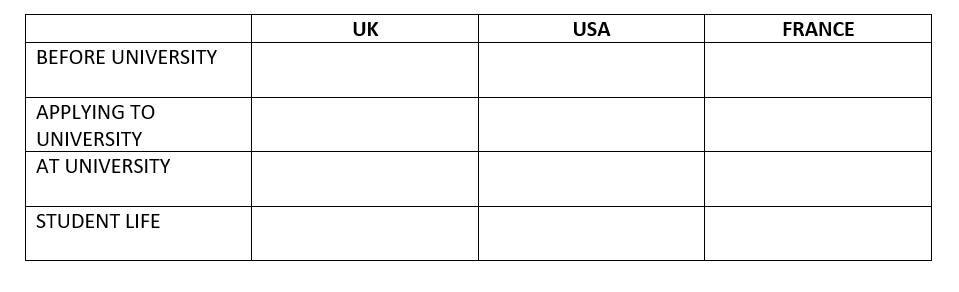 c) Grammar: Read the following recap about comparative structures.
1) Superiority
Look at the following examples:
1. Tuition fees are higher in the US than in France.
2. Tuition fees are lower in France than in England.
3. In the US, It is cheaper to attend a university in the state where your parents are resident than another state.
=> HIGH, LOW and CHEAP are short adjectives with 1 syllable.
In the comparative form, you add – er + than.
4. Finding time to have a student job is easier in the US than in France.
=> EASY is an adjective with 2 syllables BUT it ends in –y. You add – ier + than.
5. British universities are more expensive than French universities.
=> EXPENSIVE is a long adjective with 2 or more syllables. You add more + adjective + than.
You can also add less + adjective + than.
6. In the UK, the situation for students in 2018 is worse than it was for students in 1998 when tuition fees were first introduced.
=> WORSE is the adjective BAD in its comparative form.
Exceptions
Like in French, some adjectives are irregular in their comparative form
Adjectives
Comparative Form
Good
Bad
Far
Little
Much
Better than
Worse than
Farther than / Further than
Less
More
2) EqualityLook at the following examples:1. Studying in the UK is now almost as expensive as studying in the US.
2. I thought I would be homesick and lonely: but in fact studying away from home is not as bad as all that.
3. As soon as I was 18, I wanted to leave home and study in another country.
=> Structure = AS + adjective + AS
3) "alors que", "tandis que" => while, whereas4) Some more complex comparative structures:- Modulating comparisons
Look at the following examples:
1. Tuition fees are MUCH higher in the US than in France.
2. He doesn’t study very hard. He’s FAR more interested in having a good time.
3. My course is a bit boring. I would like to do something A LITTLE more interesting.
4. Deciding which universities and courses to apply for was MUCH more complicated than I initially expected.
5. It’s A LOT easier to learn a foreign language in the country where it is spoken than in a classroom.
=> You can modulate the comparison by using: Much – a lot – far – a bit – a little - slightly
- More and more…
Look at the following examples:
1. It’s becoming harder and harder to find a job – even with a Master’s degree.
2. Your English is improving: it’s getting better and better.
3. These days, more and more young people are spending a year abroad.
We repeat comparatives like this (… and ….) to say that something is changing continuously.
- The more, the more…
1. The younger you are, the easier it is to learn.
2. The more qualified you are, the easier it is to find a job.
3. The further away you live from your parents when at university, the more independent you become.
4. The more you study, the better you will do.
=> We use "the… the…" (with two comparatives) to say that one thing depends on another thing:
Other common expressions:
The bigger the better.
The sooner the better.
The more the merrier.
d) Take the following test to see what you remember:
https://ecampus.paris-saclay.fr/mod/quiz/view.php?id=2172518
- Modulating comparisons
-
-
-
-
Students mustMark as done STEP 3 - Sports studies in the world and student athletes
(⏲️ 15 min)
a) Here are a few websites that you can browse if you are interested in studying sports sciences abroad.
=> The 2020 Shanghai ranking of sports sciences schools and departments
https://www.shanghairanking.com/rankings/grsssd/2020
Which country is the most represented among the top 30 programs? Is this what you expected?
=> A website giving information about many sports sciences programs around the world
https://erudera.com/study-programs/sports-science/
b) Watch this video about what it is like to be a student athlete in college:
Pay attention to the words / expressions that mean: un engagement / une moyenne / les notes / se serrer les coudes
c) Watch this video of Richard Sherman, a NFL player (Tampa Bay Buccaneers) who graduated from Stanford University and who would like to raise awareness (to raise awareness = sensibiliser) about the difficulties that student athletes face during their education...
Take notes: what does Sherman say about the way people see student athletes? What is the reality of being a student athlete?
d) Take the following test to see what you remember:
https://ecampus.paris-saclay.fr/mod/quiz/view.php?id=2172520
-
-
Students mustMark as done STEP 4 - Adapting to cultural differences
(⏲️ 10 min)
a) Watch this video about culture shock.
If you go live abroad for a few months or maybe a year you will have to adapt to a different style of life. What is "CULTURE SHOCK" and how can you successfully adapt to another country? And how do strangers adapt to France when they come live in our country?
b) Listen to this audio about an American professional basketball player, Trenton Meacham from the ASVEL club in Lyon, talking about leaving his home country to come to France, and the difficulties he faced.
Take notes for the final wooclap (you can also listen to the audio files again while answering the wooclap questions)
c) Listen to this audio about a professional Canadian basketball coach, J.D. Jackson from the ASVEL club in Lyon, talking about leaving his home country to come to France, and all the excitement he felt.
Take notes for the final wooclap (you can also listen to the audio files again while answering the wooclap questions).
-
Students mustMark as done STEP 5 (Optional / Facultatif) - Get ready to study abroad!
Si vous êtes intéressé(e) par une mobilité étudiante, nous vous recommandons fortement de jeter un oeil à ce STEP... sinon, vous pouvez juste lire par curiosité, ou passer votre chemin !
a) How to write a CV / cover letter
To get your application for a student mobility ready, you will probably need to provide a CV (UK) or resume (US), as well as a cover letter. Look at the following presentation and read carefully so that you are up to scratch on what to do / not do!
https://view.genial.ly/633393b1c7b5620018b84fdc
You can also do the exercises on the following worksheet to make sure you have understood (les réponses aux questions du worksheet sont données au fur et à mesure de la présentation ci-dessus).
NB : si vous voulez vous entraîner à rédiger un CV / une lettre de motivation dans le cadre de votre mobilité étudiante, vous pouvez le faire et demander l'avis de votre professeur d'anglais !
b) Some useful vocabulary...
You can also learn the vocabulary in the following document (voir le document PDF ci-dessous) to talk about your experiences and skills in your application.
-
-
-
Students mustMark as done STEP 6 - Some useful information about student mobility here in Paris-Saclay
(⏲️ 5 min)
Si vous envisagez d'effectuer une mobilité étudiante, le premier site à consulter est évidemment celui de la Faculté des STAPS, sur lequel vous retrouverez toutes les informations concernant les partenariats entre la F2S et l'étranger, ainsi que les étapes pour constituer un dossier. Pour rappel, votre correspondante privilégiée dans cette démarche est Caroline TEULIER (responsable des Relations Internationales pour la F2S).
Si vous avez besoin de passer une certification en anglais pour constituer votre dossier, tous nos conseils concernant les différentes certifications et leurs modalités de passage sont dans la présentation suivante. Vous pouvez aussi contacter Emma Pillard (référente certification pour la F2S) si vous avez des questions à ce sujet.
https://view.genial.ly/6353befd2e448300124c47a3
We hope this helps a little, so that you don't have to struggle as much as Romain Duris in L'Auberge espagnole ! ;)
-
Students mustMark as done STEP 7 - Some useful vocabulary
Here is a vocabulary sheet you have to read and memorize! (voir le document PDF ci-dessous)
-
-
Students mustMark as done STEP 7 - FINAL WOOCLAP
(⏲️ 20-25 min)
Take this quiz on Wooclap to see what you have memorized from all the steps of UNIT 1.
BE CAREFUL: You can only take this quiz once, so make sure you are well prepared and don't rush! Follow the link according to your section. ATTENTION : Vous ne pouvez faire le test qu'une seule fois ; préparez vos notes et ne vous précipitez pas pour répondre ! Suivez le lien vers le Wooclap selon votre filière.
- L2 APAS with Thibaut NILLES: https://app.wooclap.com/UNIT5EPES/questionnaires/65231fa668acc58cc798fb9b
- L2 Education et motricité groups with Thibaut NILLES & Emma PILLARD: https://app.wooclap.com/UNIT5EPES/questionnaires/65231fc9ee8427b1cb2fecaa
- L2 Entraînement sportif groups with Emma PILLARD: https://app.wooclap.com/UNIT5EPES/questionnaires/65231f6c7ba5520626cd5da1
- L2 Management groups with Thibaut NILLES:https://app.wooclap.com/UNIT5EPES/questionnaires/65231fd62418cd1192743181 -
Students mustMark as done
CONGRATULATIONS! You finished UNIT 2!
(⏲️ 5 min)
-
Opened: Tuesday, 21 October 2025, 12:00 AMDue: Monday, 27 October 2025, 11:59 PM
-
Opened: Tuesday, 21 October 2025, 12:00 AMDue: Monday, 27 October 2025, 11:59 PM
-
-
Welcome to your third online class! This class is the first part of UNIT 3.
In this Unit, you will learn some content about how sports are mediatized around the world. For each STEP, we have indicated the approximate time you should spend.
For this Unit, there are 7 STEPS (see below).
When you have finished, please take a few minutes to fill in the GoogleForm at the end of the unit to give us some feedback about this unit.
PLEASE REMEMBER TO CLICK ON THE LITTLE TICK ICONE "
" on the right side of the screen for each activity, to complete the activity. This
allows your teachers to visualize your progression. Moreover, you will
not be able to complete certain STEPS unless you reach the minimum score
for a test. You may take these tests several times, to practice and
complete your STEPS! Bienvenue sur votre troisième TD en ligne ! Ce TD est la première partie du UNIT 3.Dans cet UNIT, vous allez voir du contenu sur la médiatisation du sport dans le monde. Pour chaque STEP, nous vous avons indiqué le temps approximatif que vous devriez passer dessus.
Pour ce module, il y a 7 STEPS (voir ci-dessous).
Lorsque vous aurez fini, merci de prendre quelques minutes pour remplir le GoogleForm en bas du module pour nous donner du feedback sur ce module.
ATTENTION MERCI DE VALIDER CHAQUE ÉTAPE TERMINÉE EN CLIQUANT SUR LA PETITE ICÔNE "
" à droite de l'écran liée à l'étiquette ! Cela nous aide à voir votre progression. De
plus, certains STEPS ne pourront pas être validés tant que vous n'avez pas eu
un score minimum sur un test. Vous pouvez passer ces tests plusieurs fois
afin de vous entrainer et de les valider !UNIT 3 STEPS / ÉTAPES :
STEP 1 (Listening) : Watch the video about the different types of media coverages in sport. / Regardez la vidéo sur les différents types de couverture médiatique dans le monde du sport.
STEP 2 (Listening and reading) : Watch the video about the influence of global sporting events and read an article about how these events affect athletes. / Regardez la vidéo sur l'influence des événements sportifs majeurs et lisez un article à propos de l'impact de ces événéments sur les athlètes.
STEP 3 (Grammar) : How to formulate questions in English / Révisions sur la formation grammaticale des questions en anglais
STEP 4 (Vocabulary) : Learn the vocabulary of press and the media. / Apprenez le vocabulaire de la presse et des médias.
STEP 5 (Listening) : Watch the video about sponsoring. / Regardez la vidéo sur le sponsoring
STEP 6 (Reading) : Read the article about athletes and social media. / Lisez l'article sur les athlètes et les réseaux sociaux.
STEP 7 (Memorize!) : Take the final Wooclap to see what you have memorized! Be careful, you can only take the test ONCE, so make sure that you have done all the activities from each step and that you have your notes with you before you start... / Participez au Wooclap de fin de module, pour voir ce que vous en avez retenu ! Attention, vous ne pouvez passer ce test qu'UNE SEULE FOIS. Soyez sûr d'avoir bien validé toutes les étapes précédentes avant de le passer, et d'avoir vos prises de notes avec vous..
Good luck!
-
-
Students mustMark as done STEP 1 - The different types of media coverages in sport (⏲️ 15 min)
a) Listen carefully to the following video a few times. Read the subtitles on the screen at the same time, it will really help you understand and memorize the vocabulary.
b) Take some notes to answer the following questions (you will have questions about this in your final Wooclap):
- How can you define a medium?
- What are the 4 main roles of a medium for society?
- What are the different forms of media coverage?
- What is the translation of "broadcast"?
- What are the advantages and disadvantages of the media coverage of a sport?
-
Students mustMark as done / STEP 2 - The influence of global sporting events
(⏲️ 25 min)
a) Listen carefully to the following video a few times. Read the subtitles on the screen at the same time, it will really help you understand and memorize the vocabulary.
b) Take some notes to answer the following questions (you will have questions about this in your final Wooclap):
- What is a global event? Can you give examples?
- What are the 7 advantages of hosting global events?
- What is the translation of "legacy implications"?
- How many football (or soccer) world cups have been won by the host nations?
- What are the 7 drawbacks of hosting global events?
- What are the benefits for the performers themselves? (= the athletes) Pause the video to answer this question.
c) Now read this article and answer the following questions:
https://standard.asl.org/18760/sports/the-world-is-watching-media-pressure-on-athletes/
- Whose point of view is it?
- How is the mental health of athletes influenced by media?
- Which athletes' examples are presented?
-
Students mustMark as done
Read the following presentation and memorize the rules about how to ask a question in English. STEP 3 - Grammar: How do you ask a question in English? (⏲️ 10 min)
https://view.genial.ly/623391689687530011fa800c
=> Then, take the following quiz (after STEP 4) to see what you remember!! // Le quiz est à faire après le STEP 4, car il y aura également des questions sur le vocabulaire de ce step.
-
Students mustMark as done STEP 4 - Some useful vocabulary about media
(⏲️ 10 min)
Memorize the vocabulary in the following PDF file.=> Then, take the following quiz to see what you remember!! -
-
-
Students mustMark as done STEP 5 - Sponsoring sports
(⏲️ 10 min)
a) Listen carefully to the following video a few times. Read the subtitles on the screen at the same time, it will really help you understand and memorize the vocabulary.
b) Take some notes to answer the following questions (you will have questions about this in your final Wooclap):
- What is a sponsorship and what are its 3 different forms?
- What are the advantages and disadvantages of sponsorships? -
Students mustMark as done STEP 6 - Sports and social media
(⏲️ 10 min)
a) Read the following article about a football player's social media account.
b) Take the quiz to see what you have understood.
https://docs.google.com/document/d/1H0yFbaDM-TeZNIVhEu17xujkJl7QenWTpPgunrop5hs/edit?usp=sharing
-
-
Students mustMark as done STEP 7 - FINAL WOOCLAP
(⏲️ 15-20 min)
Take this quiz on Wooclap to see what you have memorized from all the steps of UNIT 3.
BE CAREFUL: You can only take this quiz once, so make sure you are well prepared and don't rush! Follow the link according to your section. ATTENTION : Vous ne pouvez faire le test qu'une seule fois ; préparez vos notes et ne vous précipitez pas pour répondre ! Suivez le lien vers le Wooclap selon votre filière.
- L2 APAS with Thibaut NILLES:
https://app.wooclap.com/BXKHCS/questionnaires/6534d55cb362de8c35c4d1a2
- L2 Education et motricité groups with Thibaut NILLES & Emma PILLARD:
https://app.wooclap.com/BXKHCS/questionnaires/6534d592a9ddda42ff86c1dd
- L2 Entraînement sportif groups with Emma PILLARD:
https://app.wooclap.com/BXKHCS/questionnaires/6534d59f0b8cf3e718826e4e
- L2 Management groups with Thibaut NILLES: -
Students mustMark as done
CONGRATULATIONS! You finished UNIT 3!
(⏲️ 5 min)
-
-
Welcome to your fourth online class! This class is the first part of UNIT 4.
In this Unit, you will learn some content about some issues that are related to inclusion and diversity in sports. For each STEP, we have indicated the approximate time you should spend.
For this Unit, there are 8 STEPS (see below).
When you have finished, please take a few minutes to fill in the GoogleForm at the end of the unit to give us some feedback about this unit.
PLEASE REMEMBER TO CLICK ON THE LITTLE TICK ICONE "
" on the right side of the screen for each activity, to complete the activity. This
allows your teachers to visualize your progression. Moreover, you will
not be able to complete certain STEPS unless you reach the minimum score
for a test. You may take these tests several times, to practice and
complete your STEPS! Bienvenue sur votre quatrième TD en ligne ! Ce TD est la première partie du UNIT 4.Dans cet UNIT, vous allez voir du contenu sur les notions de diversité et inclusion dans le milieu sportif. Pour chaque STEP, nous vous avons indiqué le temps approximatif que vous devriez passer dessus.
Pour ce module, il y a 8 STEPS (voir ci-dessous).
Lorsque vous aurez fini, merci de prendre quelques minutes pour remplir le GoogleForm en bas du module pour nous donner du feedback sur ce module.
ATTENTION MERCI DE VALIDER CHAQUE ÉTAPE TERMINÉE EN CLIQUANT SUR LA PETITE ICÔNE "
" à droite de l'écran liée à l'étiquette ! Cela nous aide à voir votre progression. De
plus, certains STEPS ne pourront pas être validés tant que vous n'avez pas eu
un score minimum sur un test. Vous pouvez passer ces tests plusieurs fois
afin de vous entrainer et de les valider !UNIT 4 STEPS / ÉTAPES :
STEP 1 (Listening) : Watch the trailer of a French comedy about synchronized swimming... for a male team! / Regardez la bande-annonce d'une comédie française qui montre une équipe de natation synchronisée... masculine !
STEP 2 (Listening) : Listen to an audio file about sports and gender and complete the different exercises. /Écoutez un document audio à propos de la question du genre dans le sport et faites les exercices liés à cet audio.
STEP 3 (Listening + Grammar) : Watch the two Nike commercials and revise your rules about how to use adjectives. / Regardez les deux publicités Nike et révisez les règles sur l'utilisation des adjectifs en anglais.
STEP 4 (Listening + Vocabulary) : Watch the video about gender equality and learn some linking words. / Regardez la vidéo sur l'égalité hommes-femmes et apprenez des mots de liaison.
STEP 5 (Listening) : Listen to the audio files about sexism in football. / Ecoutez les documents audio sur la question du sexisme dans le football.
STEP 6 (Reading) : Read the article about the history of the Paralympic Games. / Lisez l'article sur l'histoire des Jeux Paralympiques.
STEP 7 (Listening) : Watch the video about the Invictus Games. / Regardez la vidéo sur les Invictus Games.
STEP 8 (Memorize!) : Take the final Wooclap to see what you have memorized! Be careful, you can only take the test ONCE, so make sure that you have done all the activities from each step and that you have your notes with you before you start... / Participez au Wooclap de fin de module, pour voir ce que vous en avez retenu ! Attention, vous ne pouvez passer ce test qu'UNE SEULE FOIS. Soyez sûr d'avoir bien validé toutes les étapes précédentes avant de le passer, et d'avoir vos prises de notes avec vous..
Good luck!
-
-
Students mustMark as done STEP 1 - Synchronized swimming... for men
(⏲️ 5 min)
Watch the trailer of the movie Le Grand Bain (Sink or Swim in English)
Have you ever seen this movie? What is the story? What makes this movie funny (or not so funny?)?
STEP 2 - The issue of gender in sports (⏲️ 10 min)
a) Listen carefully to this audio file a few times and take some active notes to answer questions about this in the final Wooclap.
(Tip: you can change the speed of the voice to X0.5 or X0.75 if it's too fast.)
b) Then, do the following exercises.
Exercices à partir du document audio :Fill in the 4 slides with the right words:
And now write down the fisrt sentence of the audio file:
-
Students mustMark as done
-
Students mustMark as done
-
-
-
Students mustMark as done+ STEP 3 - How can sports empower women?
(⏲️ 15-20 min)
a) Study the following Nike commercials.
Nike is famous for their commercials. Look at these two: "Dream Crazier" and "One day, we won't need this day"
1) What are all the negative adjectives that are used to describe women in sports?
2) Which special day do you think this Nike ad is referring to? In your opinion, is it still necessary to set annual dates to fight against discrimination?
3) Here is some useful vocabulary to talk about these commercials, try to memorize it!•Strength (n), strong (adj) = la force, fort(e)•Male-dominated (adj) = dominé par les hommes•Manly (adj) = viril, masculin•Female-dominated (adj) = dominé par les femmes•Butch (n ou adj) = (femme) d’apparence masculine•Gender gap (n) = fossé hommes / femmes•Upbringing (n) = éducation•Abuse (n), abusive (adj) = insultes ou abus, insultant ou violent•Raise awareness (v) = faire prendre conscience, sensibiliser•Empower (v) = valoriser, donner davantage d’importance, renforcer•Role model (n) = modèle, exemple à suivreb) Read the following recap about how tu use adjectives in English, then take the quiz to see what you have memorized!- Deux points importants à retenir pour commencer :a) En français, on peut mettre l'adjectif devant ou derrière le nom qu'il caractérise selon les situations, mais en anglais l'adjectif se place toujours DEVANT le nom.Ex : J'ai reçu un joli bouquet de roses rouges. => I got a pretty bouquet of red roses.b) En anglais, les adjectifs ne prennent JAMAIS la marque du pluriel.Ex : Je n'ai jamais vu d'aussi magnifiques roses! => ✔️I have never seen such beautiful roses! (❌ beautifuls roses)- Comment faire lorsqu'il y a plusieurs adjectifs qui caractérisent un nom ? Dans quel ordre les placer ?Puisqu'on lit une phrase de gauche à droite, en anglais on aura :=> le plus à gauche dans la phrase, les adjectifs qui sont considérés comme les plus subjectifs=> le plus à droite dans la phrase, les adjectifs qui sont considérés comme les plus objectifs.On va ainsi suivre la règle suivante : TAFCOM, comme TAILLE - AGE - FORME - COULEUR - ORIGINE - MATIERENB : tout adjectif qui se réfère à une appréciation de beauté ou d'apparence physique, va se trouver plus à gauche dans la phrase.=> Un exemple pour mieux comprendre :The beautiful big old square brown Victorian wooden house = la magnifique, grande et vieille maison carrée et marron en bois, datant de l'époque victorienne- La beauté et la taille de la maison sont considérées comme les éléments les plus subjectifs (si l'on habite dans un studio délabré cette maison paraîtrait peut-être grande et magnifique, mais si l'on vit dans un immense château, on n'aura pas forcément la même perception...).- L'âge est lui aussi un élément subjectif : on n'a pas tous la même perception de ce qui est jeune ou vieux ! Cela vaut aussi pour la nouveauté / ancienneté de qqch.- La forme est déjà moins susceptible de faire débat : la maison est carrée, et pas triangulaire.- Idem pour la couleur : si la maison est marron, elle n'est pas blanche ou verte !- L'origine de la maison est également très objective : elle date de l'époque victorienne, pas de la Renaissance ou du 21ème siècle.- La matière est considérée comme l'élément le plus objectif : c'est littéralement ce dont la maison est faite, et cela ne pose par conséquent pas de débat ! -
-
Students mustMark as done STEP 4 - Gender equality in sports
(⏲️ 10 min)
If sports empower women, can we consider that there is gender equality in sports?
Here is another video about this question.
a) Take some notes (you will have some questions about it in the final Wooclap).
b) Write a summary (= un résumé) and try to use these linking words to express a paradox or a contrast between men and women.
While, Whereas = Tandis que, alors que• Exprime un contraste entre 2 situations dans une même phrase• Ex: NBA players earn $5 million, while WNBA players earn $70 000.However, Nevertheless, Yet = Cependant / Toutefois• However exprime aussi un contraste avec ce qui a été dit précédemment, mais peut être utilisé dans une même phrase ou dans une nouvelle phrase.• Ex: Jackie Mitchell displayed great baseball skills. However, her contract was prematurely terminated.Alhough, Though, Even Though = Même si, bien que• Exprime un paradoxe entre deux idées OU une concession.• Ex: Although she was a very good player, she was never taken seriously. / Even if you played a good game, you still need to practice hard. -
Students mustMark as done STEP 5 - SPORTS AND VIOLENCE / SEXISM
(⏲️ 15-20 min)
Listen several times to these audio files (you can also change the speed of the voice to X0.5 or X0.75 if it's too fast). Take some notes because you will have some questions about them in the final Wooclap !
1) Violence towards women in sports:
2) Football and sexism Part 1:3) Football and sexism Part 2:
-
Students mustMark as done STEP 6 - The history of the Paralympic Games
(⏲️ 15 min)
a) Read the following article and take notes for the final Wooclap.
https://docs.google.com/document/d/1VotEnvZzk0cuCX6DvSLxWh5nSI3oMAw-OqnaTakYP_Q/edit?usp=sharing
b) Play this LearningApp to memorize the important vocabulary from the article.
https://learningapps.org/watch?v=p5ygpmk5k23
-
Students mustMark as done STEP 7 - The Invictus Games
(⏲️ 10-15 min)
Watch this video and take notes about the history of the Invictus Games (there will be questions about this in the final Wooclap!):
-
Students mustMark as done STEP 8 - FINAL WOOCLAP
(⏲️ 15-20 min)
Take this quiz on Wooclap to see what you have memorized from all the steps of UNIT 4.
BE CAREFUL: You can only take this quiz once, so make sure you are well prepared and don't rush! Follow the link according to your section. ATTENTION : Vous ne pouvez faire le test qu'une seule fois ; préparez vos notes et ne vous précipitez pas pour répondre ! Suivez le lien vers le Wooclap selon votre filière.
- L2 APAS with Thibaut NILLES:
https://app.wooclap.com/HRYCJS/questionnaires/6551563c32130ca3ee911dd1
- L2 Education et motricité groups with Thibaut NILLES & Emma PILLARD:
https://app.wooclap.com/HRYCJS/questionnaires/6551567bd49dfa9842576170
- L2 Entraînement sportif groups with Emma PILLARD:
https://app.wooclap.com/HRYCJS/questionnaires/6551568ab2478b9b1175f262
- L2 Management groups with Thibaut NILLES: -
Students mustMark as done
CONGRATULATIONS! You finished UNIT 4! This was your last online Unit for this semester.
(⏲️ 5 min)
 If you have any feedback for your teachers about your classes this semester, please feel free to reach out to us! :)You can also fill in this Google Form to give us some feedback anonymously.
 -
Opened: Wednesday, 3 December 2025, 12:00 AMDue: Friday, 12 December 2025, 11:59 PM
-
-
Welcome to your first online class of 2026! This class is the first part of UNIT 5.
In this Unit, you will learn the vocabulary of sport equipments and outfits. For each STEP, we have indicated the approximate time you should spend.
This will be a rather short Unit, as there are only 4 STEPS. However, we are counting on you to already know how to say: sport names / sport facilities, and when to use DO / PLAY / PRACTICE. If you don't remember any of these things, go back to UNIT 1 and study!
PLEASE REMEMBER TO CLICK ON THE LITTLE TICK ICON "
" on the right side of the screen for each activity, to complete the activity. This
allows your teachers to visualize your progression. Moreover, you will
not be able to complete certain STEPS unless you reach the minimum score
for a test. You may take these tests several times, to practice and
complete your STEPS!Bienvenue sur votre premier TD en ligne de 2026 ! Ce TD est la première partie du UNIT 5.Dans cet UNIT, vous allez apprendre les noms d'équipements et de tenus sportifs. Pour chaque STEP, nous vous avons indiqué le temps approximatif que vous devriez passer dessus.
Ce module sera plutôt court, car vous n'avez que 4 STEPS. Cependant, nous comptons sur le fait que vous sachiez déjà exprimer : les noms de sport / d'installations sportives + quand utiliser les verbes DO / PLAY / PRACTICE. Si ce n'est pas votre cas, retournez au UNIT 1 pour réviser ces points !
ATTENTION MERCI DE VALIDER CHAQUE ÉTAPE TERMINÉE EN CLIQUANT SUR LA PETITE ICÔNE "
" à droite de l'écran liée à l'étiquette ! Cela nous aide à voir votre progression. De
plus, certains STEPS ne pourront pas être validés tant que vous n'avez pas eu
un score minimum sur un test. Vous pouvez passer ces tests plusieurs fois
afin de vous entrainer et de les valider !UNIT 5 STEPS / ÉTAPES :
STEP 1 (Listening) : Watch Paul Taylor's funny video about fake anglicisms. / Regardez la vidéo humoristique de Paul Taylor au sujet des faux anglicismes.
STEP 2 (Vocabulary) : Play some LearningApps games to memorize the vocabulary of sport outfits. / Jouez à des mini-jeux LearningApps pour mémoriser le vocabulaire des tenues sportives.
=> Be careful, there is a password to memorize for each game. / Attention, il y a un mot de passe à noter pour chaque mini-jeu.
STEP 3 (Vocabulary) : Memorize the vocabulary of sport equipments. / Mémorisez le vocabulaire des équipements sportifs.
STEP 4 (Memorize!) : Take the final Wooclap to see what you have memorized! Be careful, you can only take the test ONCE, so make sure that you have done all the activities from each step and that you have your notes with you before you start... / Participez au Wooclap de fin de module, pour voir ce que vous en avez retenu ! Attention, vous ne pouvez passer ce test qu'une seule fois. Soyez sûr d'avoir bien validé toutes les étapes précédentes avant de le passer, et d'avoir vos prises de notes avec vous...
Good luck!
-
-
Students mustMark as done STEP 1 - Fake anglicisms in French (⏲️ 5 min)
Un anglicisme est un mot ou une expression qu'on emprunte à la langue anglaise ; par exemple : "donner du feedback" (to give feedback) pour dire "faire un retour" à quelqu'un. Le phénomène inverse, lorsque l'anglais emprunte au français, s'appelle un gallicisme. ("At this restaurant, you can order à la carte.") La langue anglaise fait d'ailleurs beaucoup de gallicismes dans le milieu de la restauration.
En France, il faut noter que nous avons un certain talent pour inventer de faux anglicismes, c'est-à-dire des mots qui paraissent empruntés à l'anglais, mais qui... n'existent pas dans la langue anglaise !!=> Écoutez le sketch de l'humoriste britannique Paul Taylor et faites la liste de ces faux anglicismes (avec le vrai mot qui correspond en anglais). Nous vous recommandons d'ailleurs les vidéos de Paul Taylor si vous cherchez une façon amusante d'en apprendre plus sur la langue anglaise et son histoire ! -
Students mustMark as done STEP 2 - Sport outfits (⏲️ 15-20 min)
Play these four LearningApp games to memorize some vocabulary about sport outfits (les tenues sportives).
 Il
y aura un mot de passe en 4 mots qui forment une phrase à mémoriser
pour le Wooclap final : chaque partie de ce mot de passe vous est donnée
à la fin d'un des mini-jeux ; notez-les au fur et à mesure !
Il
y aura un mot de passe en 4 mots qui forment une phrase à mémoriser
pour le Wooclap final : chaque partie de ce mot de passe vous est donnée
à la fin d'un des mini-jeux ; notez-les au fur et à mesure !Part 1: https://learningapps.org/watch?v=po3c9bb4524
Part 2: https://learningapps.org/watch?v=pz4qu5chc24
Part 3: https://learningapps.org/watch?v=psm287ogj24
Part 4: https://learningapps.org/watch?v=pxyd35q8324
To finish a game and see the answers, click on the blue button with a white check mark.
Pour prolonger les remarques de Paul Taylor sur les faux anglicismes... Un jogging, des baskets, un sweat, ou un legging sont des inventions purement françaises ! Les anglophones diront : tracksuit bottoms (UK) / sweatpants (US), trainers, tennis shoes (UK) / sneakers (US), a sweatshirt (US), yoga pants. Attention également : un short se dira toujours "shorts" en anglais, même si l'on ne parle que d'un seul short !
Idem pour les sports : en anglais, on ne peut pas dire abréger football en foot, basketball en basket ou handball en hand... On dira toujours "I play football / I play basketball / I play handball." Pour un anglophone, dire "I play foot" signifierait "Je joue du pied", alors nous vous laissons imaginer ce qu'imaginerait un anglophone si vous lui disiez "I play hand"...
Par contre, on peut entendre l'abréviation "to play some ball", souvent pour désigner "faire du basket".
-
Students mustMark as done STEP 3 - Sport equipments (⏲️ 20-25 min)
Check out the following flashcards and memorize all the names of sport equipments.
=> Ouvrez le document PDF ci-dessous pour accéder aux flashcards.
En anglais, le "qu-" se prononce toujours comme le "qu" dans le mot "quoi". Donc attention lorsque vous aurez à prononcer le mot "equipment", on ne doit pas entendre le même qu- que dans le mot "équipement" !! -
-
Students mustMark as done
- STEP 4 - FINAL WOOCLAP
(⏲️ 15-20 min)
Take this quiz on Wooclap to see what you have memorized from all the steps of UNIT 5.
BE CAREFUL: You can only take this quiz once, so make sure you are well prepared and don't rush! Follow the link according to your section. ATTENTION : Vous ne pouvez faire le test qu'une seule fois ; préparez vos notes et ne vous précipitez pas pour répondre ! Suivez le lien vers le Wooclap selon votre filière.
- L2 APAS with Thibaut NILLES:
https://app.wooclap.com/PPQJLD/questionnaires/65ada2983ac46d034d8b24d0
- L2 Education et motricité groups with Emma PILLARD:
https://app.wooclap.com/PPQJLD/questionnaires/65ada2ea9046c71c7ebd4e59
- L2 Entraînement sportif groups with Emma PILLARD:
https://app.wooclap.com/PPQJLD/questionnaires/65ada30142190fd8cc93cd6e
- L2 Management groups with Thibaut NILLES:https://app.wooclap.com/PPQJLD/questionnaires/65ada30f3ac46d034d8b3273 -
Students mustMark as done
CONGRATULATIONS! You finished UNIT 5!
Feel free to give some feedback on this unit to your teachers...
-
-
Welcome to your second online class for this semester! This class is the first part of UNIT 6.
In this Unit, you will learn the vocabulary of body parts and how to physically prepare when practicing your sport. For each STEP, we have indicated the approximate time you should spend.
For this UNIT, there are 6 steps.
PLEASE REMEMBER TO CLICK ON THE LITTLE TICK ICON "
" on the right side of the screen for each activity, to complete the activity. This
allows your teachers to visualize your progression. Moreover, you will
not be able to complete certain STEPS unless you reach the minimum score
for a test. You may take these tests several times, to practice and
complete your STEPS!Bienvenue sur votre deuxième TD en ligne du semestre ! Ce TD est la première partie du UNIT 6.Dans cet UNIT, vous allez apprendre le vocabulaire de l'anatomie et de la préparation physique avant l'effort. Pour chaque STEP, nous vous avons indiqué le temps approximatif que vous devriez passer dessus.
Pour ce module, il y a 6 steps.
ATTENTION MERCI DE VALIDER CHAQUE ÉTAPE TERMINÉE EN CLIQUANT SUR LA PETITE ICÔNE "
" à droite de l'écran liée à l'étiquette ! Cela nous aide à voir votre progression. De
plus, certains STEPS ne pourront pas être validés tant que vous n'avez pas eu
un score minimum sur un test. Vous pouvez passer ces tests plusieurs fois
afin de vous entrainer et de les valider !UNIT 6 STEPS / ÉTAPES :
STEP 1 (Vocabulary) : Play some LearningApps games to memorize the vocabulary of body parts. Then, take the quiz to see what you memorized. / Jouez à des mini-jeux LearningApps pour mémoriser le vocabulaire de l'anatomie. Ensuite, faites le quiz pour voir ce que vous avez retenu.
STEP 2 (Listening) : Watch the video about muscles, bones and joints and take notes. / Regardez la vidéo sur les muscles, les os et les articulations et prenez des notes.
STEP 3 (Listening) : Watch the video that focuses on joints and take notes. / Regardez la vidéo qui parle plus précisément des articulations et prenez des notes.
STEP 4 (Memorize) : Take the quiz about muscles, bones and joints. / Faites le quiz sur les muscles, les os et les articulations.
STEP 5 (Listening) : Watch the video about warming-up and stretching. Then, take the quiz to see what you memorized. / Regardez la vidéo sur l'échauffement et les étirements. Ensuite, faites le quiz pour voir ce que vous avez retenu.
STEP 6 (Memorize!) : Take the final Wooclap to see what you have memorized! Be careful, you can only take the test ONCE, so make sure that you have done all the activities from each step and that you have your notes with you before you start... / Participez au Wooclap de fin de module, pour voir ce que vous en avez retenu ! Attention, vous ne pouvez passer ce test qu'une seule fois. Soyez sûr d'avoir bien validé toutes les étapes précédentes avant de le passer, et d'avoir vos prises de notes avec vous...
Good luck!
-
-
Students mustMark as done STEP 1 - Body parts vocabulary (⏲️ 20 min)
Play these LearningApp games to memorize some vocabulary about:
a) Parts of your face: https://learningapps.org/watch?v=pdtx2a4x522
b) General body parts: https://learningapps.org/watch?v=p2337zmtv22
=> Memorize the vocabulary and take the following quiz!
 QUELQUES RAPPELS IMPORTANTS :
 1) En anglais, les noms de parties du corps sont neutres, donc on va utiliser le pronom "it" pour les désigner (et pas "he"ou "she").
2) Lorsqu'on va donner des instructions pour mobiliser les parties du corps : en français, on dit par exemple "Tendez les bras." Mais en anglais, on dira toujours "Extend your arms." (= Tendez vos bras.) et jamais "Extend the arms."
-
Students mustMark as done
 STEP 1 - Body parts quiz
Take the quiz to see how much you have memorized! There is ONLY ONE CORRECT ANSWER for each question.
-
Students mustViewReceive a gradeReceive a passing grade
Take the quiz to see how much you have memorized! There is ONLY ONE CORRECT ANSWER for each question.
-
Students mustMark as done STEP 2 - Bones, muscles and joints (⏲️ 10-15 min) Watch this video and take notes.
You can replay it several times to memorize it, so that you will be able to answer the 6 questions at the end of the video:
a) Which is the smallest bone in our body?
b) Which is the longest bone in our body?
c) Who has more bones, children or adults?
d) Which are the longest muscles in our body?
e) Which are the strongest muscles in our body?
f) Which is the smallest muscle in our body?
-
Students mustMark as done STEP 3 - Joints (⏲️ 10 min) Watch this video and take notes.
You can replay it several times to memorize it, so that you will be able to answer the 5 questions at the end of the video:
a) Name two places where hinge joints can be found.b) What type of joint is your hip?c) What are ligaments?d) Where are joints found?e) What does cartilage do? -
Students mustViewReceive a gradeReceive a passing grade
-
Students mustMark as done STEP 5 - Warming up and stretching out (⏲️ 15-20 min)
Watch and take notes, then take the quiz.
Si vous avez des difficultés à comprendre, focalisez-vous sur les schémas montrés dans la vidéo pour suivre les explications.
-
Students mustMark as done
-
-
Students mustMark as done STEP 6 - FINAL WOOCLAP
(⏲️ 15-20 min)
Take this quiz on Wooclap to see what you have memorized from all the steps of UNIT 6.
BE CAREFUL: You can only take this quiz once, so make sure you are well prepared and don't rush! Follow the link according to your section. ATTENTION : Vous ne pouvez faire le test qu'une seule fois ; préparez vos notes et ne vous précipitez pas pour répondre ! Suivez le lien vers le Wooclap selon votre filière.
- L2 APAS with Thibaut NILLES:
https://app.wooclap.com/IYYZRE/questionnaires/65bfdb5826141663b39a0e98
- L2 Education et motricité groups with Emma PILLARD:
https://app.wooclap.com/IYYZRE/questionnaires/65bfdb84963d13a321e7681d
- L2 Entraînement sportif groups with Emma PILLARD:
https://app.wooclap.com/IYYZRE/questionnaires/65bfdb97ab38ae9fa24091be
- L2 Management groups with Thibaut NILLES:https://app.wooclap.com/IYYZRE/questionnaires/65bfdba3ab38ae9fa24095bd
-
-
Welcome to your third online class for this semester! This class is the first part of UNIT 7.
In this Unit, you will learn more about injuries in sports and handisports, and how to prevent them. For each STEP, we have indicated the approximate time you should spend.
For this UNIT, there are 7 steps.
PLEASE REMEMBER TO CLICK ON THE LITTLE TICK ICON "
" on the right side of the screen for each activity, to complete the activity. This
allows your teachers to visualize your progression. Moreover, you will
not be able to complete certain STEPS unless you reach the minimum score
for a test. You may take these tests several times, to practice and
complete your STEPS! Bienvenue sur votre troisième TD en ligne du semestre ! Ce TD est la première partie du UNIT 7.Dans cet UNIT, nous allons parler de blessures et de prévention, dans le sport et le handisport. Pour chaque STEP, nous vous avons indiqué le temps approximatif que vous devriez passer dessus.
Pour ce module, il y a 7 steps.
ATTENTION MERCI DE VALIDER CHAQUE ÉTAPE TERMINÉE EN CLIQUANT SUR LA PETITE ICÔNE "
" à droite de l'écran liée à l'étiquette ! Cela nous aide à voir votre progression. De
plus, certains STEPS ne pourront pas être validés tant que vous n'avez pas eu
un score minimum sur un test. Vous pouvez passer ces tests plusieurs fois
afin de vous entrainer et de les valider !UNIT 7 STEPS / ÉTAPES :
STEP 1 (Listening and reading) : Listen to an online article, watch a video and read a presentation to memorize some advice about preventing sports injuries. / Ecoutez un article en ligne, regardez une vidéo et lisez une présentation pour mémoriser des conseils afin d'éviter les blessures liées au sport.
STEP 2 (Listening) : Watch the video about warming up and take the quiz to see what you understood. / Regardez la vidéo sur l'échauffement et faites le quiz pour voir si vous avez bien compris.
STEP 3 (Vocabulary) : Play the LearningApps games to learn the vocabulary about protective gear, common injuries and safety, then take the quiz. / Jouer aux mini-jeux LearningsApps pour apprendre le vocabulaire des équipements de protection, des blessures et de la prévention, puis faites le quiz.
STEP 4 (Reading) : Take a look at some statistics about the most dangerous sports, and learn more about how to express numbers in English. / Réfléchir au classement des sports les plus à risques et lire le recap sur les nombres en anglais.
STEP 5 (Reading and listening) : What should you do if there is an emergency? Take notes about a text and a video. / Comment réagir en cas d'accident ? Prendre des notes sur un texte et une vidéo.
STEP 6 (Vocabulary) : Play a LearningApp game to learn some vocabulary about adapted sports and read the text about how the classification at the Paralympic Games works. Then, take the quiz. / Jouer à un mini-jeu LearningApp pour apprendre le vocabulaire sur les sports adaptés et lire le texte sur la classification des handicaps aux Jeux Paralympiques, puis faire le quiz.
STEP 7 (Memorize!) : Take the final Wooclap to see what you have memorized! Be careful, you can only take the test ONCE, so make sure that you have done all the activities from each step and that you have your notes with you before you start... / Participez au Wooclap de fin de module, pour voir ce que vous en avez retenu ! Attention, vous ne pouvez passer ce test qu'une seule fois. Soyez sûr d'avoir bien validé toutes les étapes précédentes avant de le passer, et d'avoir vos prises de notes avec vous...
Good luck!
-
-
Students mustMark as done / STEP 1 - Prevention tips (⏲️ 15-20 min)
How can we avoid injuries while practicing sports ? Find out by doing the three following activities.
a) Click on the following link to access an online article about what to do to avoid sports injuries.
https://kidshealth.org/en/kids/sport-safety.html
You can also listen to the article to memorize the correct pronunciation. Click on
 at the top of the page and follow what your hear by reading the words that appear in green and blue.
b) Now watch this Australian video about ways to prevent sports injuries with children:
c) To finish this step, read this Powerpoint presentation and pay attention to the advice that is given to you:
https://docs.google.com/presentation/d/1tUDNXVv1S3um7LEG4Noy3CB_0YNCTfrc7tgr18Q4QRQ/edit?usp=sharing
=> What seems most important for you in order to prevent injuries ?
-
Students mustMark as done STEP 2 - What is a good warm-up?
(⏲️ 10-15 min)
Warming up seems to be one of the most important tips to prevent injuries... But what is a good warm-up ? This following video questions: Should we continue wasting time with warm-ups... ?
a) Take some notes while watching this video.
b) Now take the quiz to see what you have memorized.
-
-
Students mustMark as done STEP 3 - Injuries and safety vocabulary (⏲️ 15 min) Play these three LearningApp games to memorize some vocabulary about injuries and safety.
- LearningApp n°1: https://learningapps.org/display?v=p445fawxa22
- LearningApp n°2: https://learningapps.org/display?v=pfryvtjfk22
- LearningApp n°3: https://learningapps.org/display?v=p3gxhi6e222
- LearningApp n°1: https://learningapps.org/display?v=p445fawxa22
-
Students mustMark as done
Take the quiz to see how much you have memorized! There is ONLY ONE CORRECT ANSWER for each question.
-
Students mustMark as done STEP 4 - Statistics about sports injuries / Talking about numbers in English.
(⏲️ 15 min)
a) Look at the statistics about sports-related injuries. Are they what you expected?
In the United States, according to the National Safety Council (NSC), in 2021, exercise equipment accounted for about 409,000 injuries, the most in any category of sports and recreation (= les loisirs).
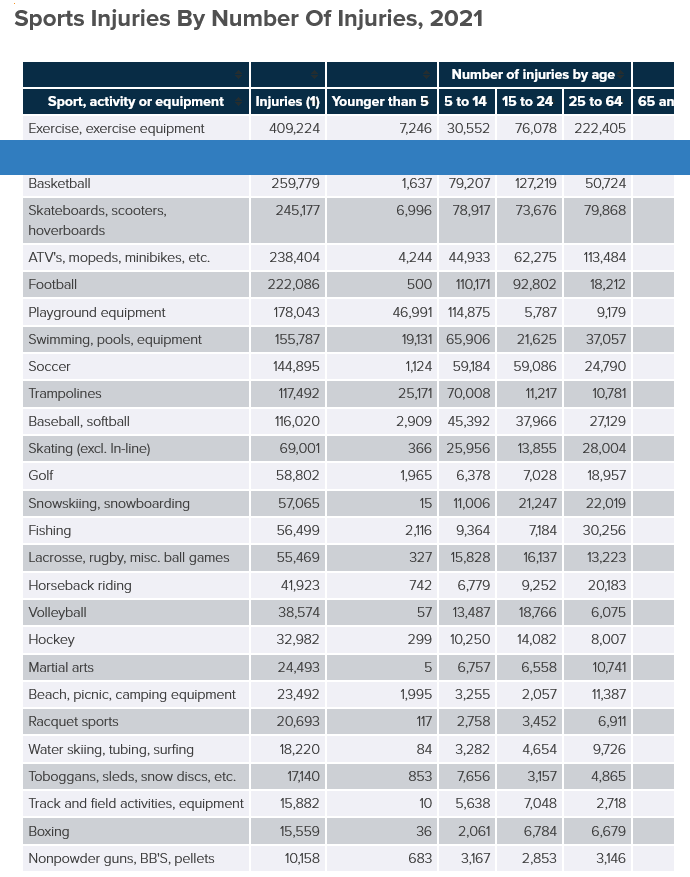
Source = https://www.iii.org/fact-statistic/facts-statistics-sports-injuries
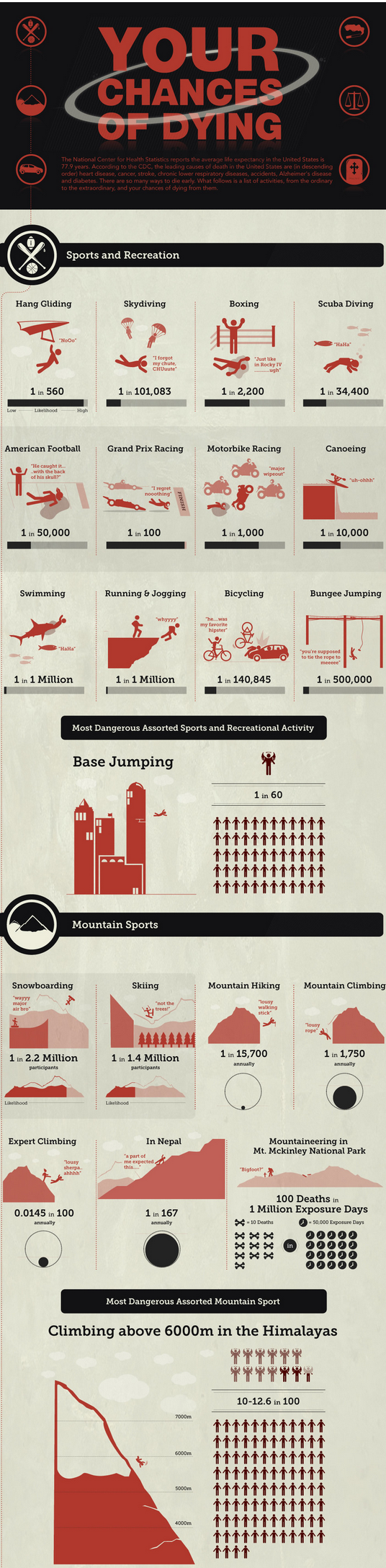
Source = https://www.tetongravity.com/story/news/your-chances-of-dying-ranked-by-sport-and-activity
b) Read the recap about how to read / write numbers in English.
https://docs.google.com/document/d/14ApkbesvZrU_lD5IDD2GNkR2UiT3Xc1TicUw-8iC_-o/edit?usp=sharing
-
Students mustMark as done/ STEP 5 - How to handle an emergency
(⏲️ 15 min)
a) Read this text and listen to it at the same time with the audio file.
https://kidshealth.org/en/kids/emergency.html
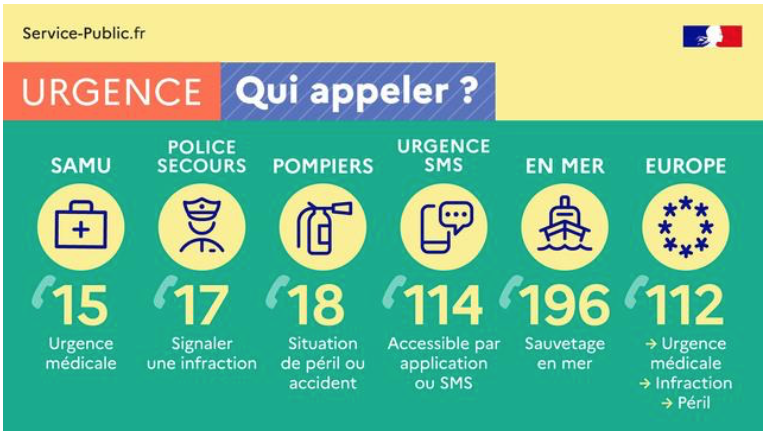
b) Now watch this video that tells you when to call the emergency in a sport accident :
These are the numbers you can call in France if you have to deal with one of these 5 major injuries.
-
Students mustMark as done STEP 6 - Injuries and disabilities (⏲️ 15 min)
a) Play this mini-game to memorize some vocabulary about sports-related disabilities:
https://learningapps.org/watch?v=p86k7i4mj22
b) Read the following text about disability categories in the Paralympics, and take notes:
https://docs.google.com/document/d/1kdmh01S8n0hABYTclkd0Yw6kwGlAsNW_fzHWAT9K3h4/edit?usp=sharing
-
Students mustMark as done
Take the quiz to see how much you have memorized! There is ONLY ONE CORRECT ANSWER for each question.
-
Students mustMark as done STEP 7 - FINAL WOOCLAP (⏲️ 20 min)
Take this quiz on Wooclap to see what you have memorized from all the steps of UNIT 7.
BE CAREFUL: You can only take this quiz once, so make sure you are well prepared and don't rush! Follow the link according to your section. ATTENTION : Vous ne pouvez faire le test qu'une seule fois ; préparez vos notes et ne vous précipitez pas pour répondre ! Suivez le lien vers le Wooclap selon votre filière.
- L2 APAS with Thibaut NILLES:
https://app.wooclap.com/AHPTHS/questionnaires/65d50289d5e808f43abbcbb4
- L2 Education et motricité groups with Emma PILLARD:
https://app.wooclap.com/AHPTHS/questionnaires/65d502aa3c928cd54eb29cb8
- L2 Entraînement sportif groups with Emma PILLARD:
https://app.wooclap.com/AHPTHS/questionnaires/65d502bcd5e808f43abbe25d
- L2 Management groups with Thibaut NILLES:
https://app.wooclap.com/AHPTHS/questionnaires/65d502c9019d04c0178f44f2
-
-
Welcome to your last online class for this semester! This class is the first part of UNIT 8.
In this Unit, you will learn how to explain the rules and regulation of your sport. For each STEP, we have indicated the approximate time you should spend.
For this UNIT, there are 6 steps.
PLEASE REMEMBER TO CLICK ON THE LITTLE TICK ICON "
" on the right side of the screen for each activity, to complete the activity. This
allows your teachers to visualize your progression. Moreover, you will
not be able to complete certain STEPS unless you reach the minimum score
for a test. You may take these tests several times, to practice and
complete your STEPS! Bienvenue sur votre dernier TD en ligne du semestre ! Ce TD est la première partie du UNIT 8.Dans cet UNIT, vous allez apprendre à parler des règles et du règlement de votre sport. Pour chaque STEP, nous vous avons indiqué le temps approximatif que vous devriez passer dessus.
Pour ce module, il y a 6 steps.
ATTENTION MERCI DE VALIDER CHAQUE ÉTAPE TERMINÉE EN CLIQUANT SUR LA PETITE ICÔNE "
" à droite de l'écran liée à l'étiquette ! Cela nous aide à voir votre progression. De
plus, certains STEPS ne pourront pas être validés tant que vous n'avez pas eu
un score minimum sur un test. Vous pouvez passer ces tests plusieurs fois
afin de vous entrainer et de les valider !UNIT 8 STEPS / ÉTAPES :
STEP 1 (Listening) : Watch a video of the Youtube channel "Ninh explains" to better understand how one can present the rules of a sport. / Regardez la vidéo de la chaîne Youtube "Ninh explains" pour mieux comprendre comment on peut présenter les règles d'un sport.
STEP 2 (Listening and Grammar) : Watch the video how to prevent winter sports injuries and read the grammar recaps about modal verbs and how to express rules + give advice; then, take the quiz to see what you have understood. / Regardez la vidéo sur la prévention des blessures dans les sports d'hiver et lisez les recap de grammaire sur les auxiliaires de modalité et comment exprimer une règle + un conseil; ensuite, faites le quiz pour voir ce que vous avez compris.
STEP 3 (Listening) : Watch the videos to understand how rules can evolve within a sport, and how this happened in the case of basketball. / Regardez les vidéos pour comprendre comment les règles d'un sport peuvent évoluer avec le temps, et plus particulièrement avec le cas du basketball.
STEP 4 (Listening) : Watch the videos about the rules and the physics of football. / Regardez les vidéos sur les règles et les lois physiques qu'on peut appliquer aux tirs en football.
STEP 5 (Vocabulary) : Look at the presentation about the vocabulary of shots in sports. / Consultez la présentation pour apprendre le vocabulaire des tirs en sport.
STEP 6 (Memorize!) : Take the final Wooclap to see what you have memorized! Be careful, you can only take the test ONCE, so make sure that you have done all the activities from each step and that you have your notes with you before you start... / Participez au Wooclap de fin de module, pour voir ce que vous en avez retenu ! Attention, vous ne pouvez passer ce test qu'une seule fois. Soyez sûr d'avoir bien validé toutes les étapes précédentes avant de le passer, et d'avoir vos prises de notes avec vous...
Good luck!
-
Students mustMark as done STEP 1 - "Ninh explains the weirdest sports" (⏲️ 10-15 min)
Can we practice any sport as long as we have rules to regulate it ? Watch this video to find out, and take notes!
-
Students mustMark as done / STEP 2 - Safety first! How to express rules and advice (⏲️ 25 min)
a) Watch the following video. Write down the 10 pieces of advice that are given in order to avoid winter sports injuries.
b) Read the recap about modal verbs.
https://docs.google.com/document/d/1Thnx5Hz39yIEa8z-gNOOe9U_PVx6ZlZMeuQXQOYpjQg/edit?usp=sharing
c) Read the recap about expressing rules and giving advice.
https://view.genial.ly/635f9ed6d4903100133a2565
d) Take the following quiz to practice. Use your notes about the Winter Sports Injuries video.
-
Students mustMark as doneTake the following quiz to see what you have memorized about expressing safety rules and advice in English.
-
-
Students mustMark as done STEP 3 - How do rules evolve within a sport? (⏲️ 20 min)
The rules of a game or a sport can change throughout time.
Who decides of the rules? Why should we change some of the rules ?
Here is an example with the history of basketball:
This little video for kids conveys (= transmettre, véhiculer) a very American point of view!
Let's have a look at another video about the history of basketball and the NBA and see how the game has evolved:
Now, what rules should you know to play basketball ?
-
Students mustMark as done STEP 4 - Explaining the rules of a sport: the example of football/soccer (⏲️ 20 min)
You probably already know the rules of soccer. But are you able to explain in English the off-side rule for example? Or the names of the different fouls?
You probably have in mind a lot of great goals in soccer! (for example at the 2018 World Cup, which France won...)
According to you, what would the best free kick goal of all times be?
Did you know this one that Roberto Carlos scored for Brazil against France in 1997?
If we look beyond the game and look at the laws of physics, did you know we could also apply physics rules to this game and to the ball??
-
Students mustMark as done STEP 5 - Passes and shots (⏲️ 10 min)Read the following presentation about passes and shots; memorize as much vocabulary as you can!
-
Students mustMark as done STEP 6 - FINAL WOOCLAP
(⏲️ 15-20 min)Take this quiz on Wooclap to see what you have memorized from all the steps of UNIT 8.
BE CAREFUL: You can only take this quiz once, so make sure you are well prepared and don't rush! Follow the link according to your section. ATTENTION : Vous ne pouvez faire le test qu'une seule fois ; préparez vos notes et ne vous précipitez pas pour répondre ! Suivez le lien vers le Wooclap selon votre filière.
- L2 APAS with Thibaut NILLES:
https://app.wooclap.com/KECURA/questionnaires/65ef561a46f5e6beea0658fd
- L2 Education et motricité groups with Emma PILLARD:
https://app.wooclap.com/KECURA/questionnaires/65ef5631232516722d3986a7
- L2 Entraînement sportif groups with Emma PILLARD:
https://app.wooclap.com/KECURA/questionnaires/65ef56524420334a762ea628
- L2 Management groups with Thibaut NILLES:https://app.wooclap.com/KECURA/questionnaires/65ef56624420334a762eaa6a -
Students mustMark as done
Présentation générale pour ce TD : https://view.genially.com/69b7cf7668306ff0adb2c27e
1) Test de connaissances sur le UNIT 8 et correction du test sur le UNIT 7
- Voir la partie 1 de la présentation
2) Activité d'expression orale par groupes de 3-4 étudiants : Inventer sa nouvelle fédération sportive et les règles d'un nouveau sport- Voir les règles du jeu dans la partie 2 de la présentation
- Voir la partie 1 de la présentation
-
-
🇫🇷 A partir de la semaine 13 (lundi 23/03) vous pouvez envoyer par mail votre projet vidéo à votre enseignant d'anglais.
=> Vous avez jusqu'au dimanche 12/04 (avant 23h59) pour nous faire parvenir votre travail. Merci de vérifier que votre devoir est correctement titré et envoyé dans les temps (sinon vous aurez au moins un point de pénalité !).
Si votre travail est trop volumineux pour la boîte mail, merci de passer par le site WeTransfer pour générer un lien de téléchargement, à envoyer par mail à votre enseignant.
🇬🇧 Starting from week 13 (Monday March 23rd), you may send your video project to your English teacher, by email.
=> Your video must be turned in by Sunday, April 12th (before 11:59 pm) at the latest. Make sure to give a proper title and to submit your homework in time (or else you will have at least 1 point taken off your grade!).
If your video is too long to be sent directly through email, please use the WeTransfer website, which will allow you to generate a download link for your teacher (which you will then need to email to your teacher).
-
-
Voilà les liens du Wooclap pour les groupes de L2 qui auront leur dernier TD de l'année en distanciel (L2 EM gr1/gr2/gr3 + L2 ES gr2 et gr3).
Ce Wooclap est uniquement destiné à faire des révisions de fin d'année, mais il est obligatoire ! Il devra avoir été complété d'ici le mercredi 15/04 au plus tard.
L2 EM groupe 1 : https://app.wooclap.com/UMUPAO/questionnaires/69d0df672632a3791d379e26
L2 EM groupe 2 : https://app.wooclap.com/UMUPAO/questionnaires/69d0df8e2632a3791d37b381
L2 EM groupe 3 : https://app.wooclap.com/UMUPAO/questionnaires/69d0df83f967057b8dcb26b9
L2 ES groupe 2 : https://app.wooclap.com/UMUPAO/questionnaires/69d0df7ff967057b8dcb235c
L2 ES groupe 3 : https://app.wooclap.com/UMUPAO/questionnaires/69d0dfb62632a3791d37c297
-
-
Click on the following link to acess our Padlet, where we have listed many resources for you to improve your English. This will also be useful if you would like to get extra information on how to take a certification exam or prepare for a year of studying abroad. Cliquez sur le lien ci-dessous pour accéder à notre Padlet, sur lequel nous avons déposé de nombreuses ressources pour vous aider à améliorer votre anglais. Ce Padlet vous sera également utile si vous cherchez des informations concernant le passage d'une certification ou la préparation d'une mobilité étudiante.
